

Offset vs Inset Strategies: When to Use Which
- C² Team
- Mar 17
- 10 min read
Understanding the Value Chain Distinction That Is Reshaping Corporate Climate Credibility
Carbon offsetting has been a cornerstone of corporate climate strategy for the better part of two decades. The logic is intuitive, the mechanics are well-established, and the market infrastructure that supports it, from verified carbon standards to broker platforms to corporate procurement frameworks, has developed into a multi-billion dollar industry. Companies with emissions they cannot immediately eliminate buy credits representing reductions achieved elsewhere, net the two figures against each other, and make claims about their climate performance on that basis.
For a long time, this was considered not just acceptable but progressive. Today, the picture is more complicated. The scrutiny applied to offset-based climate claims has intensified dramatically, driven by investigative journalism exposing the quality problems in voluntary carbon markets, by evolving guidance from the Science Based Targets initiative and the Voluntary Carbon Markets Integrity Initiative that places increasingly strict limits on the role offsets can play in net zero claims, and by a growing body of investor and regulatory opinion that treats heavy reliance on offsets as a signal of strategic avoidance rather than genuine decarbonisation.
Into this shifting landscape has emerged a concept that is gaining significant traction among companies with complex supply chains and ambitious Scope 3 reduction targets: insetting. Understanding the distinction between offsetting and insetting, knowing when each strategy is appropriate, and grasping the regulatory and framework implications of each is now a core competency for any sustainability professional building a credible corporate climate strategy.
What is Carbon Offsetting?
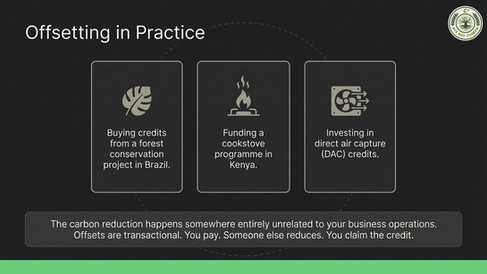
Carbon offsetting is the practice of compensating for greenhouse gas emissions produced within a company's operational or value chain boundary by funding activities that reduce or remove an equivalent quantity of greenhouse gases somewhere outside that boundary. The compensation happens through the purchase of carbon credits, each of which represents one tonne of CO2 equivalent either avoided or removed from the atmosphere by a certified project.
The universe of offset project types is broad. Avoided deforestation projects, operating under frameworks such as REDD+ (Reducing Emissions from Deforestation and Forest Degradation), generate credits by protecting forests that would otherwise have been cleared. Renewable energy projects in developing markets generate credits by displacing fossil fuel generation that would otherwise have occurred. Cookstove projects generate credits by providing cleaner cooking technologies to households that would otherwise burn biomass or coal. Methane capture projects at landfills or agricultural facilities generate credits by preventing methane from reaching the atmosphere. More recently, engineered carbon removal approaches including direct air capture, biochar application, and enhanced weathering are generating removal credits that represent the physical extraction of CO2 from the atmosphere.
The quality of carbon credits varies significantly across this landscape, and the quality question is central to the credibility of offset-based climate claims. The major voluntary carbon standards, including Verra's Verified Carbon Standard, the Gold Standard, and the American Carbon Registry, provide third-party certification frameworks that verify the additionality, permanence, and quantification methodology of offset projects. Additionality means that the emissions reduction would not have occurred without the revenue generated by carbon credit sales. Permanence means that the carbon stored or avoided will remain out of the atmosphere over a defined timeframe. These two criteria are the primary axes along which offset project quality is assessed, and both have been the subject of significant controversy in recent years, particularly for forestry-based projects where the permanence of carbon storage is vulnerable to wildfires, land use change, and political instability.
For companies, offsetting serves a legitimate and well-defined purpose within a properly structured climate strategy. It allows organisations to address residual emissions, meaning those that remain after all technically and economically feasible operational reductions have been made, and to make interim climate claims while longer-term reduction programmes are implemented. The key constraint, which is increasingly being formalised in guidance from standard-setting bodies, is that offsets should not substitute for genuine emissions reductions within a company's own boundary. They are a tool for managing what cannot yet be eliminated, not a mechanism for avoiding the hard work of reducing emissions at source.
What is Carbon Insetting?
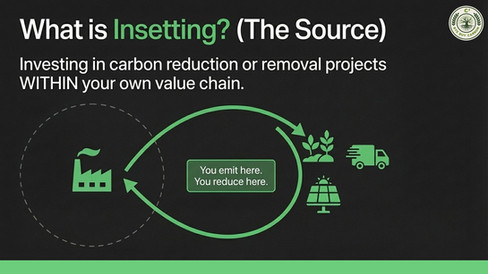
Carbon insetting is the practice of investing in carbon reduction or removal activities within a company's own value chain, specifically within the upstream or downstream activities that contribute to its Scope 3 emissions profile. Rather than compensating for emissions by funding projects in unrelated geographies or sectors, insetting directs investment toward reducing the emissions that are directly connected to the company's own business operations, supply relationships, and product lifecycles.
The concept of insetting emerged most prominently from the food and agriculture sector, where companies with significant upstream agricultural supply chains recognised that their largest Scope 3 emissions were generated by the farmers, cooperatives, and land management practices that produced their raw material inputs. A coffee company whose Scope 3 footprint is dominated by the agricultural emissions of the farms supplying its beans, or a chocolate manufacturer whose supply chain runs through cocoa-growing regions with significant deforestation risk, cannot meaningfully address its value chain emissions by buying forest protection credits in an unrelated geography. The emissions source and the intervention need to be connected.
Insetting programmes typically take the form of direct investment in or payments to supply chain actors for adopting practices that reduce emissions or sequester carbon. A food company might fund the transition of contracted farmers from conventional to regenerative agricultural practices that rebuild soil organic carbon, reduce synthetic fertiliser use, and improve water retention. A fashion brand might invest in the installation of renewable energy at supplier manufacturing facilities, reducing the Scope 2 emissions of those suppliers and thereby the purchasing brand's Scope 3 Category 1 footprint. A logistics company might fund the electrification of its contracted carrier fleet, reducing the transport emissions that contribute to its Scope 3 Category 4 and Category 9 inventory.
The defining characteristic of insetting is the value chain connection. The emissions being reduced are the same emissions that the investing company is responsible for in its Scope 3 inventory. The investment strengthens the supply chain relationship while simultaneously reducing the emissions embedded within it. This dual benefit, combining decarbonisation with supplier development, is one of the reasons insetting has attracted growing interest from companies with complex agricultural and manufacturing supply chains.
The Value Chain Distinction in Framework Terms
The distinction between offsetting and insetting is not merely conceptual. It has direct and material implications for how emissions reductions are accounted for, reported, and claimed under the frameworks that govern corporate climate disclosure.
Under the GHG Protocol Corporate Standard, the foundational framework for corporate emissions accounting, offsets are explicitly excluded from a company's emissions inventory. A company cannot reduce its reported Scope 1, Scope 2, or Scope 3 emissions figure by purchasing carbon credits from projects outside its boundary. Offsets are separately tracked and disclosed as compensation instruments, not as reductions to the inventory itself. This means that a company making a net zero claim on the basis of offsetting is not claiming to have reduced its emissions to zero. It is claiming to have compensated for residual emissions that remain in its inventory after all feasible reductions have been made.
Insetting, by contrast, directly reduces the emissions that appear in a company's Scope 3 inventory, provided that the emissions reductions achieved through the inset programme are properly measured, verified, and attributed according to established accounting methodologies. When a food company funds regenerative agriculture practices with its contracted farmers and those practices result in verified reductions in agricultural emissions, the company's Scope 3 Category 1 footprint falls. This is a genuine reduction to the emissions inventory, not a compensation mechanism applied on top of it.
The Science Based Targets initiative, whose Corporate Net-Zero Standard has become the primary reference framework for corporate net zero commitments, makes this distinction foundational. Under the SBTi Corporate Net-Zero Standard, companies are required to reduce their Scope 1, Scope 2, and Scope 3 emissions by at least 90% relative to a base year before any residual emissions can be neutralised through carbon removal. The standard places strict limits on the use of offsets to compensate for emissions reductions that should be achieved through operational changes. Insetting activities that generate verified Scope 3 reductions, by contrast, contribute directly to the reduction targets that the standard requires.
The Voluntary Carbon Markets Integrity Initiative has developed the Claims Code of Practice, which provides guidance on the conditions under which companies can make credible carbon credit-related claims. The VCMI framework distinguishes between claims based on beyond-value-chain mitigation, meaning offsets, and claims based on within-value-chain mitigation, meaning insetting, and provides different criteria for the credibility of each type of claim. The direction of travel in the VCMI framework is consistent with broader market and regulatory trends: offsets remain a legitimate tool for specific purposes, but their scope of application is being more precisely defined and their quality requirements are being raised.
When to Use Offsetting
Offsetting remains a legitimate and important component of a well-structured corporate climate strategy when applied in the right circumstances and with appropriate rigour around credit quality.
The primary appropriate use of offsets is to address residual emissions. No company operating in the real economy today can reduce all of its emissions to zero through operational changes alone. There will always be a category of emissions, perhaps a hard-to-abate industrial process, a supply chain segment where low-carbon alternatives are not yet technically or economically available, or a business travel requirement that genuinely cannot be eliminated, for which operational reduction is not yet feasible. For these residual emissions, well-verified offset credits from high-quality projects represent an appropriate and credible compensation mechanism.
Offsetting is also appropriate as a bridging strategy. A company with an ambitious long-term reduction roadmap may choose to use offsets in the near term to make climate claims while the operational investments and supply chain transformation programmes that will deliver structural reductions are being implemented. This is acceptable under most frameworks provided that the use of offsets is disclosed transparently, that the roadmap toward operational reductions is credible and time-bound, and that the offsets used are of verified quality.
For emissions in Scope 1 and Scope 2 that are not yet amenable to operational reduction, high-quality offsets from certified removal projects represent the most credible compensation approach, particularly as the market for engineered carbon removal, including direct air capture and bioenergy with carbon capture and storage, develops the scale and cost profile needed for mainstream corporate procurement.
The quality criteria that should govern offset procurement are non-negotiable for any company seeking to make credible climate claims. Credits should be additional, meaning the emissions reduction would not have occurred without the carbon finance. They should be permanent, meaning the stored or avoided carbon will remain out of the atmosphere over the defined crediting period. They should be verified by an independent third party against a recognised standard. They should not be double-counted, meaning the same tonne of reduction should not be claimed by both the project host country under its Nationally Determined Contribution and the purchasing company under its corporate target. And for companies making net zero claims, the SBTi and VCMI guidance strongly favours carbon removal credits over avoidance credits for the purposes of neutralising residual emissions.
When to Use Insetting
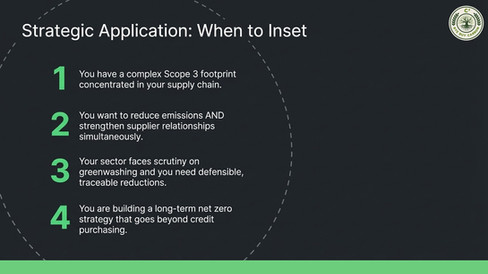
Insetting is the appropriate strategy when a company's most material emissions sit within its value chain, when it has the supply chain relationships and influence needed to drive emissions reductions at the source, and when it is seeking to build a net zero strategy that will withstand the increasing scrutiny being applied to Scope 3 claims.
For companies in the food and beverage, fashion and apparel, consumer goods, and retail sectors, the majority of the carbon footprint typically sits in upstream agricultural or manufacturing supply chains. For these companies, insetting is not merely an alternative to offsetting. It is the only approach that addresses the emissions where they actually arise, and it is the only approach that will deliver the Scope 3 reductions that SBTi-aligned targets require.
Insetting is also the appropriate strategy for companies facing reputational risk around the credibility of their climate claims. As investigative scrutiny of offset quality has intensified, companies that can demonstrate direct investment in reducing the emissions embedded in their own supply chains are in a significantly stronger position than those relying primarily on credit purchases from projects with no connection to their business. The traceability and strategic coherence of insetting programmes, when properly documented and verified, provides a level of narrative credibility that offset portfolios, however carefully selected, struggle to match.
The implementation of an effective insetting programme requires several elements that are more demanding than offset procurement. It requires a detailed understanding of where Scope 3 emissions sit within the value chain and which supply chain actors are responsible for the most significant emission sources. It requires the willingness and ability to engage those supply chain actors directly, which involves commercial relationships, technical assistance, and often financial support for the transition costs they face. It requires a measurement and verification methodology appropriate to the emission sources being targeted, which for agricultural insetting programmes may involve soil carbon sampling, satellite monitoring, and agronomic modelling. And it requires governance and disclosure practices that allow the emissions reductions achieved to be independently verified and credibly claimed.
The investment in building this capability is substantial, but for companies with the supply chain relationships and strategic ambition to do it well, insetting delivers a combination of outcomes that no offset portfolio can replicate: genuine Scope 3 reductions, stronger supplier relationships, supply chain resilience, and a sustainability narrative grounded in direct value chain action.
Using Both Together
Offsetting and insetting are not mutually exclusive, and the most sophisticated corporate climate strategies use both in a deliberately structured combination. The general architecture of a strategy that combines both approaches looks as follows.
The first priority is genuine emissions reduction within the company's own Scope 1 and Scope 2 boundary through operational changes including energy efficiency, renewable energy procurement, fuel switching, and process innovation. The second priority is Scope 3 reduction through supply chain engagement, insetting programmes, and product design changes that reduce the emissions embedded in the value chain. High-quality offsets are used to compensate for residual emissions that cannot yet be addressed through the first two priorities, and the residual offset requirement is actively managed down over time as operational and supply chain reductions progress.
This architecture is consistent with the requirements of the SBTi Corporate Net-Zero Standard, with the VCMI Claims Code of Practice, and with the direction of regulatory travel in major markets. It is also the architecture most likely to produce climate claims that are credible, defensible, and durable as standards and scrutiny continue to evolve.
The Bottom Line
The distinction between offsetting and insetting is ultimately a distinction between compensation and transformation. Offsetting compensates for emissions by funding reductions elsewhere. Insetting transforms the emissions profile of the value chain itself. Both have a role, but the balance is shifting, and the companies that understand where each strategy is appropriate, and build programmes that use both with rigour and transparency, are building the kind of climate credentials that will hold up under the scrutiny of regulators, investors, and customers who are becoming increasingly sophisticated in their ability to distinguish genuine decarbonisation from its appearance.
Offsets are a tool for the residual. Insetting is a strategy for the source. Knowing which you need, when you need it, and how to execute it well is the difference between a climate strategy that is credible and one that is merely claimed.
👉 Connect with C² (Csquare) to get started! 🌐 csquarecarbon.com ✉️ info@csquare.co.in







Comments